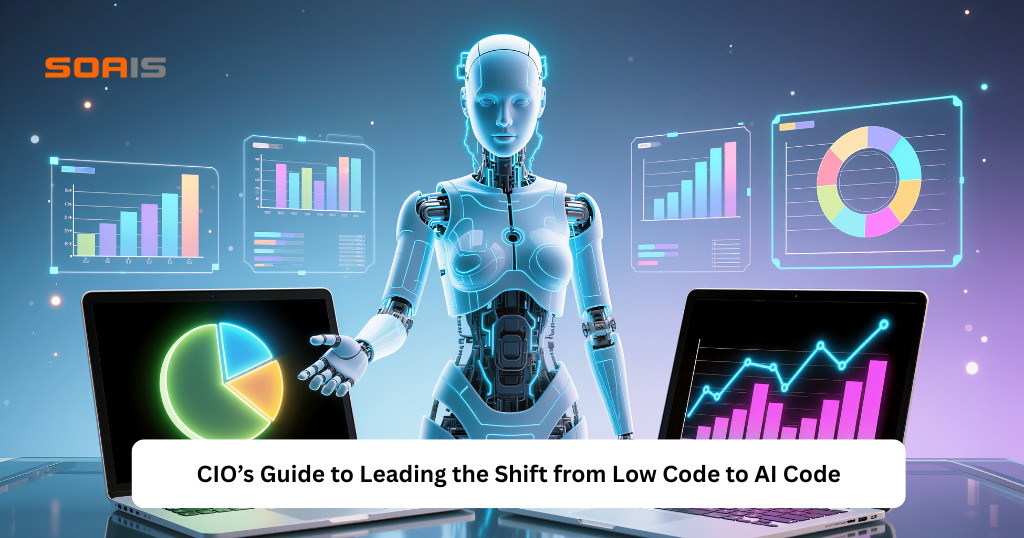
The CIO’s Guide for Leading the Transition from the Low-Code Era to the AI-Coded Era
For years, the enterprise strategy for speed was low-code and no-code, which served as great equalizers. They gave teams the ability to build fast without needing full engineering depth. However, we are now crossing a threshold into a fundamentally different era: AI-coded development.
While low-code accelerated the human act of building, AI-coded development changes the agent of building. In a low-code environment, an analyst still explicitly defines the flow. In an AI-coded environment, the system begins to design its own logic based on the outcomes it observes. It writes the code, deploys it, optimizes it, and even updates it based on how people interact with it.
This is not the future. It is already happening inside early-adopting enterprises. Internal tools, dashboards, and process applications are increasingly being built not by developers, but by models. Your development function is expanding from people writing applications to machines generating logic
This shift requires an operating model rewrite.
Because when AI starts writing logic faster than your teams can test, approve, or even document it, your traditional guardrails will start to bend.
That’s why, the era of asking ‘how fast can we ship?’ is over. The only metric that matters now is ‘how fast can we trust?
That is what this playbook is about.
I will walk you through what is changing, where the blind spots are, and what checks, balances, and structures you need to have in place so your organization can embrace AI-coded development confidently, without losing control, compliance, or credibility.
5 Silent Risks That Bypass Traditional Controls
In an AI-coded environment, risk moves faster than governance. When systems generate and modify their own logic, risks no longer appear through failed builds or ticket requests; they appear quietly inside logs and data.
These are the top 5 risk surfaces that traditional controls will miss:
- Shadow Code
Risk: Logic is generated by AI outside of approved governance or CI/CD pipelines. This often occurs when teams experiment with non-sanctioned assistants or when models are granted wide access during pilot projects.
Impact: You accumulate untracked logic running in production without QA coverage or audit trails. This is the new iteration of shadow IT, and it grows quietly unless deliberately monitored. - Explainability Gaps
Risk: AI models generate functioning code without documenting the reasoning or intent behind it.
Impact: When an auditor or regulator demands a root-cause explanation for a specific workflow decision, you need evidence, not guesses. Without enforce lineage, you lose the ability to explain how your systems evolved. - Model Drift (The Silent Error)
Risk: Unlike static code, AI models are probabilistic. Over time, a model may gradually shift how it interprets the same input or instruction.
Impact: The underlying logic shifts even if the code appears stable. This creates invisible errors in financial calculations, HR decisions, or workflow approvals. - Prompt and Data Leakage
Risk: Sensitive internal data is exposed through prompts or used inadvertently in model training. Impact: AI models can retain fragments of prompts or configuration data. If this information leaves your controlled environment, it becomes a permanent data privacy and IP risk. - Regulatory Debt
Risk: AI adoption is outpacing regulatory frameworks, yet standards like NIST AI RMF and ISO/IEC 42001 are rapidly defining accountability.
Impact: Regulators will expect AI-generated systems to meet the same standards as any other business-critical application. Failing to map assurance processes to these emerging frameworks creates significant technical and compliance debt.
6 Structural Changes to Build “Continuous
Assurance” for Code That Changes Daily.
To manage a software estate that evolves autonomously, the fundamental structures of
the IT organization must shift. You cannot govern a continuously evolving environment
with processes designed for quarterly releases.
The following six pillars represent the core redesign required to transition from delivering
software to governing trust.
1. Assurance Becomes Continuous and Embedded
Traditional QA relies on a “build, then test” cycle, which fails when logic is generated and updated in real-time. In an AI-coded world, assurance can no longer be a final gatekeeper at the end of the line; it must run parallel to the code generation itself.
- Event-Driven Validation: Replace quarterly regression runs with automated validation cycles triggered immediately by every AI-generated change.
- Integrated QA Pipelines: Connect QA tools directly to AI build systems to intercept and validate output before it affects business logic.
- Predictive Testing: Utilize AI-driven impact analysis to identify which business processes are at risk from a specific logic change.
2. Ownership Shifts from Authorship to Outcomes
When AI systems modify logic autonomously, the concept of a “developer of record” disappears. You cannot simply ask “who wrote this?”. Accountability must be redefined around outcomes.
- Outcome Accountability: Assign clear ownership for every AI-generated function to specific business and IT teams, even if no human authored the code.
- Shared Responsibility Models: Establish frameworks where QA, operations, and business owners share liability for the results of the system.
- Defined Escalation: Set thresholds for when AI decisions require human review based on risk impact.
3. Change Management Evolves into Change Awareness
In traditional IT, change management is gated by approvals. In AI-coded environments, change happens continuously. The goal shifts from “permissioning” every change to maintaining total “awareness” of every change.
- Telemetry over Tickets: Move from static approval tickets to live telemetry dashboards that track every AI-generated logic edit in real-time.
- Automated Root Cause: Implement systems that instantly identify the prompt, data, or condition that triggered a logic shift.
- Drift Alerts: Configure alerts to trigger only when system behavior deviates from established business rules.
4. Evidence by Design (Automated Lineage)
AI models do not document their reasoning unless explicitly architected to do so. Relying on post-hoc evidence collection is a liability; documentation must be automated to ensure audit readiness.
- Auto-Documentation Pipelines: Enforce mandatory logging of prompts, model versions, and generated artifacts for every deployment.
- Central Lineage Store: Maintain a repository that maps exactly when, how, and why a specific piece of logic was created.
- Explainability Checkpoints: Require automated “explainability reports” as a condition for any logic to pass into production.
5. Budgeting for Trust
The cost dynamics of IT are inverting. While AI reduces the cost of creation (development), it sharply increases the cost of assurance (validation and monitoring).
- Reallocated Spend: Shift budget from development staffing to continuous monitoring infrastructure, audit automation, and AI behavior tracking.
- Lifecycle Management: Fund the ongoing management of models, prompts, and validation data as permanent assets.
- New Cost Centers: Recognize that “confidence” is the new cost center.
6. Governance Expands to Machine Logic and Data
Governance charters must expand beyond application logic to include the behavior of the models and the data that drives them. If you cannot trust the data, you cannot trust the AI-generated logic.
- Model Management: Governance now includes tracking model versions, retraining cycles, and drift usage.
- Data as a Control: Validate and classify every dataset used for prompting or training. Data masking and lineage are now mandatory governance checks.
- Vendor Traceability: Update third-party contracts to ensure vendors provide activity logs for AI generation and guarantee that no enterprise data is retained for model training.
Forget the 5-Year Plan. You Need a 90-Day Sprint to Regain Control
To prepare your organization for the AI-coded era, you do not need a five-year strategy. You need a 90-day sprint that establishes visibility, control, and assurance. This roadmap integrates the necessary governance frameworks into a phased execution plan.
This is what I recommend as your first three months of action.
Days 0–30: Discovery and Visibility
Goal: Identify the “Shadow AI” footprint and assign immediate ownership.
- Inventory AI Activity: Run discovery scans to identify every team experimenting with AI assistants, code generators, or automation platforms. Identify unregistered scripts or generated modules running in production without QA coverage.
- Map “Shadow Code”: specifically look for logic generated outside of approved CI/CD pipelines.
- Establish the “AI Operations Office”: Form a small, cross-functional command center connecting QA, InfoSec, Compliance, and IT Operations. This group will oversee model lifecycles and centralize governance decisions.
- Assess Readiness Gaps: Review current QA and documentation processes to identify where they will fail if logic begins changing daily.
Days 30–60: Build the Governance Foundation
Goal: Distinct rules of engagement and technical guardrails.
- Define the AI Development Policy: Explicitly define who can use AI to generate code, which models are approved, and what level of human approval is required for deployment.
- Implement Prompt and Data Governance: Enforce data masking before it reaches any model. Restrict model access to governed environments only.
- Automate the Documentation Pipeline: Build the technical capability to auto-log prompt inputs, model versions, and generated artifacts. This is critical for future explainability.
- Modernize Vendor Contracts: Update agreements to ensure third-party tools provide full activity logs and guarantee your data is not used for model training. Ensure you have portability rights to export model artifacts if you switch vendors.
- Upskill QA Talent: Begin training QA engineers to understand model drift, bias, and AI assurance techniques.
Days 60–90: Activate Continuous Assurance
Goal: Move from static governance to active, real-time assurance.
- Integrate QA with AI Pipelines: Connect automated testing directly to the generation pipeline. Every new AI output should trigger an immediate validation cycle.
- Simulate an AI Incident: Treat AI failure like a cyberattack. Run a controlled scenario such as a mock model drift or a rogue logic update and measure the time to detect, rollback, and restore evidence.
- Establish Board Reporting: Present the first governance dashboard. Shift the metric from “speed” to “maturity,” highlighting model coverage, explainability readiness, and audit visibility.
- Automate Audit Evidence: Configure testing tools to flow results and lineage logs directly into your audit system, ensuring “evidence by design”.
Post-90 Days: Scale and Mature
Once the foundation is secure, focus on scaling. Priorities shift to expanding assurance across all enterprise systems, automating compliance reports for external regulators, and using AI itself to monitor generated code for unapproved changes.
The 3 Levers to Lead with Trust in an AI-Coded World
Trust is the New Currency. You have spent your entire career mastering speed, scalability, and cost control. But now, your primary Key Performance Indicator (KPI) will change. It will no longer be speed; it will be trust.
In the low-code era, success meant releasing faster. In the AI-coded era, success means ensuring that what you release is reliable, ethical, and transparent.
Speed can be copied. Trust cannot.
To maintain trust when the “developer” is a machine, you must pull three specific levers:
- Transparency by Architecture: Do not hide AI logic behind black boxes. Design systems that automatically record which model made a change, what data triggered it, and what validations occurred.
- Visible Accountability: Never accept “the model did it” as an answer. Every AI-generated decision must have a clear human owner responsible for the outcome.
- Auditability as Strength: Treat audits not as compliance burdens, but as proof of control. When you can demonstrate automated lineage and explainable logic, you prove that innovation and governance can coexist.
Conclusion
AI will make building software effortless, but it will never make trust effortless. Every automated line of code makes your organization faster but also more exposed.
Your role is no longer just enabling digital transformation; you are now the chief custodian of digital trust. Your mandate is to build an enterprise that moves at the speed of AI without losing its grip on compliance or quality.
The future is being written line by line, by machines that move faster than we ever imagined. Your job is not to stop that future. Your job is to make sure your enterprise can trust it.