In the highly integrated and broad world of SAP ERP, or SAP Material Management (SAP MM), material types are one of the most misunderstood, yet foundational concepts. Although they may seem like another piece of master data for an organization, the material type is actually a control lever that allows an organization to control how the material will behave throughout Logistics, Major Procurement, Minor Procurement, Inventory, Production, and Payment.
In other words, the material type in SAP provides the identity, behaviour, and business rules of every material that has been defined in SAP. The material type defines everything about a material, from the way that it will be procured and assessed to the GL Accounts that will be impacted by the transactions associated with that material, and even to the information that has been defined and created in the Master Record of that material. Therefore, not only are the material types in SAP a configuration object, but they also play a key role in the long-term operational and financial success of an organization.
Let’s examine what the material types are in SAP and why they are important, how they work within the SAP environment, and how organizations can focus on them as a tool for driving automated, accurate, and controlled business processes.
What Is a Material Type in SAP?
SAP defines a material type as a group of materials with the same business characteristics and processing rules. The material type determines the following information regarding the material:
- Procurement method – whether the material is purchased or produced internally
- How the material should be handled in stock – whether it is stock-managed or consumed directly
- Valuation of the material in accounting
- Which fields in the material master record are required, and which are optional
- How the material will be treated in inventory management, MRP Purchasing, Sales and Finance
SAP does not require companies to define rules for each material type, therefore, SAP provides material types as templates. All the controls, views and behaviours assigned to a material type are automatically assigned to all materials that belong to that material type.
The material type is compared to the “DNA” of a material master record.
The Importance of Material Types to Business Operations
In implementing SAP, many companies do not realise the extent of the impact of the use of material types. The material type is a critical component of:
- Financial Accuracy
- Inventory Visibility
- Procurement Efficiency
- Production Planning
- Compliance and Audit Control
- Automation and Governance of Data
For example, if a company assigns a material that incorrectly identifies GL postings to be done for the material, the following may occur:
- There may be an incorrect posting of an investment (GL) account to the GL account
- The company may not be able to account for all the available inventory on the balance sheet
- There may be a broken MRP plan
- The value of the material could be determined inaccurately
- The company’s financial statements could be inaccurate due to misallocation of inventory or overvaluation of the material
And so, you see that having a good material type structure provides the following benefits:
- Master data is clean
- Financial integration can happen automatically
- Procurement and valuation processes can remain consistent
- Audit controls are strong
- Business transparency is available throughout the entire course of business
How Material Types Regulate Material Master
Material types help define how a given material can be used in the system through multiple configuration dimensions. We will look at the most important control areas.
1. Number Range Assignment
Every material type has a number range assigned to it and this defines how material numbers are produced:
- Internal Number Assignment – The material number is autogenerated by SAP.
- External Number Assignment – The material number is entered by the user.
For instance:
- High Volume Operational Items Use Internal Numbering
- Legacy Materials and Customer Driven Items May Use External Numbering To Enable Traceability
This creates a logical flow of number generation that prevents duplication within a category of materials.
2. Field Selection Control
Material type controls which fields are mandatory, optional, display-only, or hidden across all material master views.
For example:
- A service material (DIEN) does not require storage location or stock valuation fields
- A raw material (ROH) requires purchasing, accounting, and MRP views
This ensures:
- Mandatory Fields
- Optional Fields
- Display-Only Fields
- Hidden Fields
Along with providing:
- Quality Data
- Less User Error
- Faster Material Creation
- Role-Based Relevancy
In effect, Field Selection Creates an Intelligent Input Form for Material Master That Adapts to Any Business Context.
3. Valuation & Quantity Control
Material types determine if:
- Stock is to be recorded
- Inventory Value is maintained
- Both stock quantity and value will be updated
- Neither quantity nor value will be maintained
Examples:
- ROH, HALB, FERT → Quantity + Value maintained
- DIEN (service) → No stock, no cash value
- NLAG (non-stock) → Usually, no cash value at the inventory level
This is critical for:
- Inventory Accounting
- Financial Reconciliation
- Cost of Goods Sold (COGS)
- Integrity of Balance Sheet
4. Procurement Method Control
Material types also indicate how a material is procured:
- External Procurement (Purchased from vendors)
- Internal Manufacturing (Produced via production orders)
- Service based
- Traded or Resale
Example:
- ROH → Purchased Externally
- HALB & FERT → Typically Produced Internally
- TRAD → Purchased and then Resold without Manufacturing
Direct Impact on:
- MRP Behaviour
- Purchase Requisition Creation
- Production Order Creation
- Supply Chain Planning Logic
5. Account Determination and Financial Integration
This is the greatest way how SAP Material Types exhibit their true strategic value. Material Types are linked with Valuation Classes which then feed Automatic Account Determination to Financial Accounting (FI).
Control of postings to:
- Goods Receipt
- Goods Issue
- Inventory Re-evaluation
- Price Differences
- Consumption Postings
Examples:
- Raw materials may post to Raw Inventory G/L Account
- Finished Goods may post to Finished Goods Inventory G/L Account
- Trading Goods may post to Trading Inventory G/L Account
With this integration being automated, it eliminates the need for manual intervention. The integration provides real-time visibility into financial impacts as well as audit-ready postings and accuracy in the balance sheet of the organization.
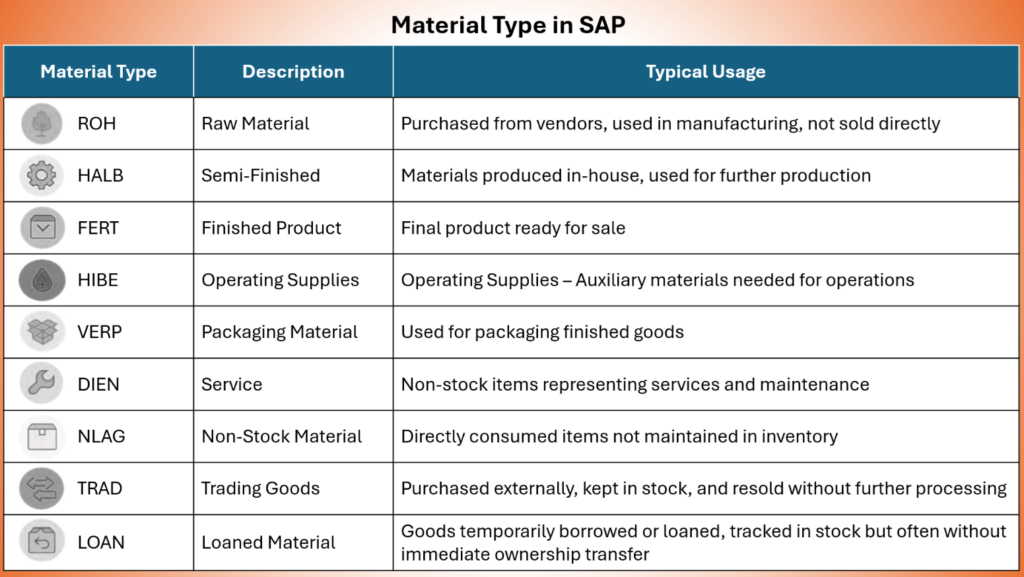
Common and Standard Material Types available through SAP
SAP provides a number of out-of-the-box Standard Material Types that can cover nearly every industry and
associated business processes.
- ROH – Raw Material
Raw materials are used in manufacturing and are considered basic materials that have been procured from vendors.
Characteristics of Raw Materials:
- Materials are procured externally
- Material is managed via stock
- Material has a valuation maintained
- Material is relevant for MRP (Material Requirements Planning)
- Valuation of Inventory and consumption postings occurs on the material
Examples of Raw Materials: Steel, Plastic Granules, Chemicals, Fabric, etc.
- HALB – Semi-finished Goods
Semi-finished goods are materials manufactured internally and later utilized within the production process.
Characteristics of Semi-finished Goods:
- Material is produced via Production Order
- Material is managed via stock
- Material has a valuation maintained
- Material is used as a component of higher-level assemblies
Examples of Semi-finished Goods include – Subassemblies, Intermediate Products, etc.
- FERT – Finished Goods
Finished goods represent all final items that are ready for sale.
Characteristics of Finished Goods:
- Material is managed via stock
- Material is relevant for Sales Orders
- Material has a valuation maintained
- Material drives revenue from Sale
- Material COGS at time of Goods Issue
Examples of Finished Goods: Cars, Appliances, Packaged Consumer Goods, etc.
- HIBE – Operating Supplies
Operating Supplies are consumable products used for the purpose of conducting business internally and are not part of the finished goods.
Some common Examples of Operating Supplies:
- Lubricants
- Cleaning Agents
- Maintenance Supplies, etc.
Whether or not Operating Supplies are managed through stock is a function of the needs of the business.
- VERP – Packaging Material
When using packaging materials, there are two categories of finished product packaging materials which will appear either to the customer or to an organization for internal logistics.
These packaging items could include bottles, boxes, pallets and cartons.
- DIEN – Services
When providing a service that is not made from a physical object, this would be classed as service material.
The key characteristics of service materials are that they are not stock, valued at inventory, or used for divulging to another company/supplier for pricing purposes, which represents the greatest proportion of service materials.
Key Characteristics:
- No stock
- No valuation at inventory
- Used purely for purchasing and cost posting
Examples: Consulting, maintenance services, transport services
- NLAG – Non-Stock Materials
Non-stock materials are those that are consumed immediately after purchase and are not stored in inventory and is recorded as a consumable item so that handling is easier than if they had to be recorded under normal inventory methods.
Examples:
- Office supplies
- Low-value tools
- Disposable items
- Direct consumption posting ensures simplified handling
- TRAD – Trading Goods
Trading goods are those items purchased for resale and have not been manufactured by the reseller. Trading goods will be classified in sales as finished goods however in procurement classed as raw material.
Examples:
- Retail products
- Wholesale distribution items
They behave like finished goods in sales but like raw materials in procurement.
- LOAN – Loaned Materials
Loan materials are temporary materials that have been borrowed or loaned by a customer. Loan materials will show on physical inventories, and because they exist in the warehouse, they will be tracked for quantity, but they do not typically impact a company’s ownership or valuation until they are received, installed, or sold. Loan materials are commonly used when renting/leasing or allowing a customer to trial equipment.
- Appear in inventory
- Are tracked for quantity
- Typically, do not affect ownership or valuation immediately
Used in rental, leasing, or customer trial scenarios.
The Significance of Selecting the Appropriate Material Type
The selection of the incorrect material type at the time of creating a material will set in motion an uncountable number of problems which will ultimately lead to incorrect valuation, broken MRP outcomes, inaccurate financial reporting, mismatched inventories, and/or audit issues.
The correct selection of material type provides for:
- Direct Processing
- Non-Contact Procurement
- Exact Tracking of Costs
- Real-Time Financial Processing
- Robust Data Governance Connected to Materials
Material Types are among the most significant design components in an SAP Implementation or S/4 Transformation Project from an SAP Architect’s point of view.
Material Types in S/4HANA Are Now More Important Than Ever!
The Transition to SAP S/4HANA, Material Types Have Gained Increased Importance with the Following.
- Valuation of Inventory in Real Time
- Universal Journal Integration (ACDOCA)
- Embedded Analytics
- Enhanced Overall MRP
- Role Specified Fiori Apps
Now, if there is a material type design inconsistency it’s felt swiftly in the Following Areas.
- Finance
- Supply Chain
- Analytics
- Compliance Reporting
This is Why Fixing Material Type Governance Is Critical in All SAP Landscapes.
Conclusion: Material Types in SAP represent so much more than a grouping of various materials, they encompass both structural methodology and controls for:
- Design of Master Data
- Management of Inventory
- Behaviour of Procurement
- Planning of Production
- Integration with Financial Accounting
- Automation/Compliance
Every material movement and financial consequence is controlled by SAP Material Types.
When implemented properly, Material Types:
- Ensure Consistency of Data
- Ensure Financial Accuracy
- Automate Processes
- Optimise Operations
When Material Types are ignored or misapplied, they can lead to:
- Mismatched Inventory
- Errors when Posting Financial Transactions
- Inconsistent Reporting
- Failed Business Processes
In summary, Material Types are much more than a simple descriptor of material. Material Types represent the cornerstone of an intelligent, integrated enterprise and are the basis for the automated operation of a business.