
Oracle’s quarterly updates provide continuous innovation, but organizations only realize their full value when new features are adopted strategically. A structured adoption framework helps reduce risk, improve collaboration, streamline testing, and accelerate the delivery of business value. With the right planning, governance, and automation, organizations can transform quarterly updates from routine maintenance into a competitive advantage.
Oracle Fusion Applications offer regular changes through regular, quarterly updates. These deliver new features, enhancements, and important fixes across the ERP suite. In recent years, updates have included the rollout of AI-driven capabilities and other innovations that can help our organization stay competitive and prepare for the future.
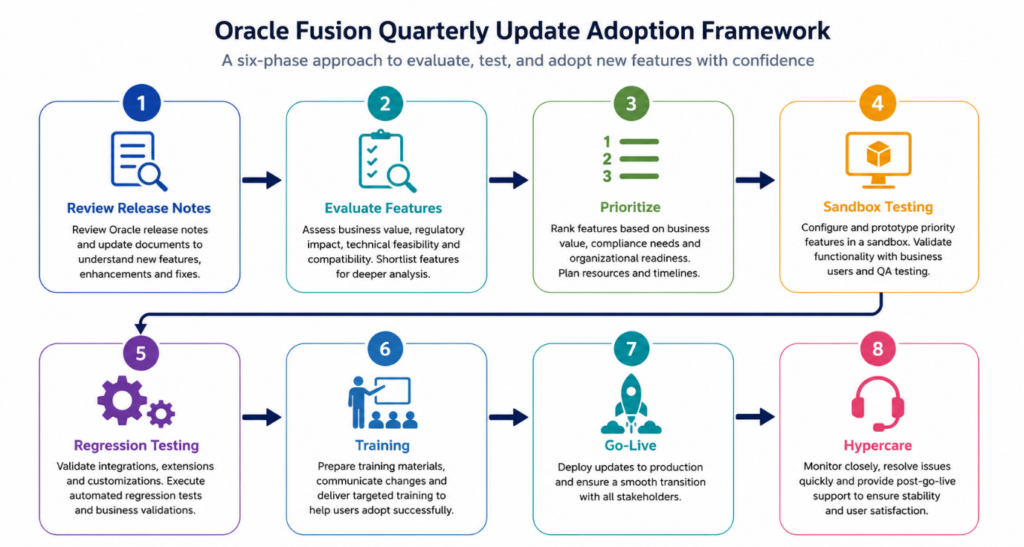
A phased path and structured staffing plan are essential for the timely evaluation, testing, and adoption of new features with minimal escalations. We have to keep in mind that the names of the roles mentioned below are not as important as the functions they fulfil. Likewise, these aren’t full-time commitments and it’s possible for one person to perform more than one role. Let’s look at each phase in turn.
1. Evaluate New Features and Assess Business Impact
Purpose: Identify the new features that are important to the organization
In this phase, IT or members of an implementation team review “what’s new” release notes and other update documentation to assess the importance, regulatory implications, and potential impact of new features. They are responsible for the initial stage, and they shortlist features for deeper review. These may include a combination of features that appeal to business users (e.g., the introduction of AI to a key workflow, updated compliance capabilities, etc.) and ones that have technology implications (e.g., impact integrations, allow for the deprecation of customizations, etc.). Fusion functional analysts can collaborate to evaluate technical feasibility and compatibility with existing configurations.
2. Prioritize Features Based on Business Value
Purpose: Help the organization select
Next, a feature steering committee composed of IT leadership, key business stakeholders, and functional analysts’ ranks the new features based on business value, compliance requirements, and organizational readiness. Project or change managers oversee next steps, aligning calendars, allocating resources, and making sure regulatory and change-control requirements are met.
3. Proof of concept (POC) and sandbox testing
Purpose: Ensure that new features function as intended to meet the requirements of business stakeholders
In this phase, Fusion solution architects configure and prototype priority features in a sandbox environment, collaborating with business users for feedback. QA testers prepare and execute test scripts for new features. They also integrate user acceptance criteria.
4. Integration and regression testing
Purpose: Make sure that new features won’t break anything, especially application integrations, extensions, and customizations (we recommend the use of automated testing tools here)
In this phase, technical consultants update integration flows (e.g., via Oracle Integration Cloud), custom reports, and automation scripts as needed. Test automation engineers run automated regression scripts to validate existing processes. And super users can be key participants for end-to-end business validation.
5. Training, documentation, and change management
Purpose: Help end users and stakeholders successfully adopt new features and processes
In this phase, a training or communications lead creates training materials, documents process changes, and delivers targeted refresher training for end users. A change management analyst runs internal communications, FAQs, and help desk readiness.
6. Cutover and post-go-live support
Purpose: Smooth the transition to the updated system and provide rapid resolution of post-release issues
In this final phase, a hypercare SWAT team monitors for unexpected disruptions, triages issues, and escalates service requests to Oracle or integration partners as needed.
Tailoring the Adoption Framework to Your Organization
The exact number of people and amount of time required to evaluate, implement, and roll out updates will vary from organization to organization. In general, larger companies and those in regulated industries might expect to invest more. What’s important is setting up a plan and dedicating resources to fulfill roles, with the understanding that some amount of experimentation will likely be required to optimize the process over time.
When External Expertise Can Help
Most organizations carefully prioritize how they allocate resources, and those working with updates to Fusion Apps are no exception. In cases where full staffing isn’t available internally, many companies supplement internal teams with external “day two” services to help:
- Tackle complex tasks or configurations that exceed internal expertise or bandwidth, such as major integrations or regression testing frameworks.
- Provide extra capacity during update cycles, helping to prevent burnout for internal teams and supporting key activities like testing, proof of concept, and hypercare after go-live.
- Deliver ongoing managed services for routine needs, such as maintaining automation scripts, advising on new features, and handling support requests.
These managed services are usually delivered on a flexible basis by partners, allowing you to scale up support during major update periods while maintaining a lean internal team for routine operations.
Benefits of a Structured Oracle Fusion Adoption Framework
- Faster adoption of Oracle innovations
- Reduced deployment risk
- Higher quality releases
- Improved collaboration between business and IT
- Faster regression testing through automation
- Better compliance
- Greater ROI from Oracle Fusion
Summary
Oracle’s quarterly updates provide continuous innovation, but organizations only realize their full value when new features are adopted strategically. A structured adoption framework helps reduce risk, improve collaboration, streamline testing, and accelerate the delivery of business value. With the right planning, governance, and automation, organizations can transform quarterly updates from routine maintenance into a competitive advantage.