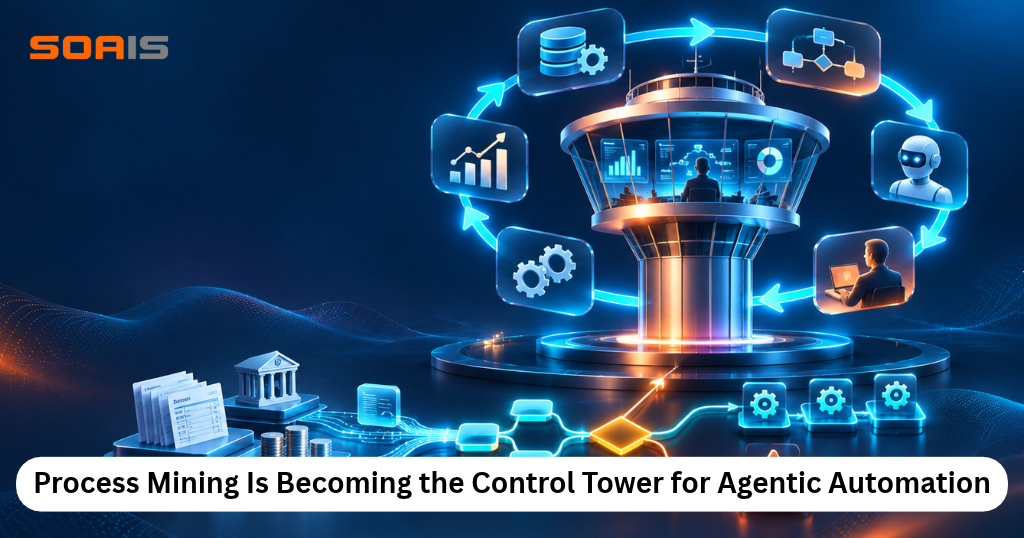
Process Mining Is Becoming the Control Tower for Agentic Automation
Why the tool we used to pick automation candidates is now the best way to watch, tune and cut the cost of AI agents after go-live.
Most automation teams know process mining as a discovery tool. You run it before a project, find the variants and bottlenecks, pick the processes worth automating, and move on. That picture is changing. As AI agents take on more multi-step work across enterprise systems, process mining is being pulled into a new job: watching what automation does and using that evidence to improve it.
This post explains the shift, shows a five-stage loop you can adopt, and walks through a worked example from bank reconciliation, a process where exceptions are the whole story.
From discovery tool to operating layer
Traditionally, process mining reconstructs real workflows from event logs in ERP, CRM and ticketing systems. It tells you how work really flows, not how the process document says it flows. Teams used it once, at the start, to build the business case.
Agents change the economics of that approach. A scripted bot does the same thing every time, so one design review is often enough. An agent chooses its own steps, and it can choose differently on Tuesday than it did on Monday. That makes ongoing visibility essential.
Industry analysts increasingly describe process mining as moving from a retrospective analytics tool toward operational infrastructure for agentic AI. Some go further: process mining can be pointed at the execution trails left by the agents themselves, so recurring patterns can be turned into simpler, more predictable and lower-cost workflows.
That second idea is the most practical one for delivery teams. Agents are good at working out what to do. Once a pattern repeats often enough, it is cheaper and safer to run it as a deterministic step.
The closed loop: five stages
A useful way to think about the upgrade path is a loop with five stages, where each stage feeds the next and the last feeds the first.
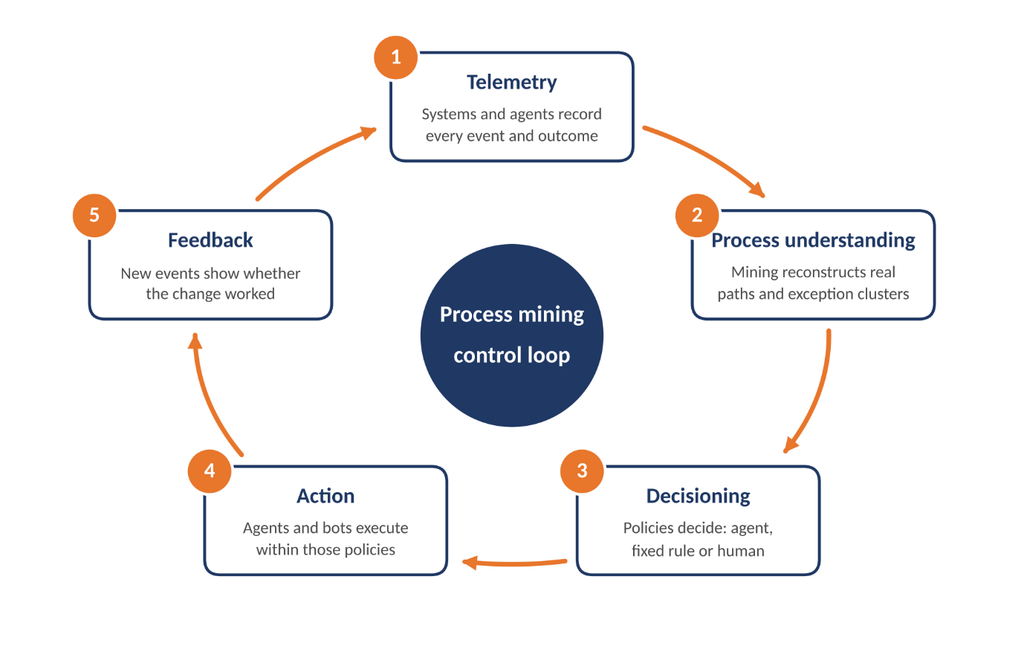
Each stage needs a clear owner and a measure of success:
| Stage | Who owns it | What to track |
|---|---|---|
| 1. Telemetry | Platform and integration team | Share of agent decisions logged with evidence and overrides |
| 2. Process understanding | Process mining analyst, business analyst | Main exception clusters and how often each occurs |
| 3. Decisioning | Process owner, risk and compliance | Override rate, and which patterns move from agent to fixed rule |
| 4. Action | Automation team | Cost per item and cycle time |
| 5. Feedback | Delivery manager, process owner | Exception rate per cluster over time |
Some practitioners treat the mined process as a living contract that the automation layer relies on, rather than a one-off report. If the real process drifts away from the contract, the loop should show it.
Worked example: bank reconciliation exceptions
We looked at how agents handle bank reconciliation in Beyond Scripted Bots. Here is how process mining keeps them in check after go-live.
The situation. A finance operations team reconciles daily statements from many banks. An AI agent handles unmatched items: it reads the statement, works out how debits and credits are shown, and proposes matches even when reference numbers are missing. Humans review what it cannot resolve.
Figures are illustrative, chosen to show the method. They are not from a real client.
Step 1: capture the agent’s trail
For a month, every agent decision is logged as an event: statement source, exception type, evidence used, the match proposed, whether a human overrode it, and time taken.
Step 2: mine the exceptions
Mining the trail groups the agent-handled exceptions into clusters, and shows how each one is being resolved:
| Exception pattern | Share of agent-handled items (illustrative) | What the trail shows | Decision |
|---|---|---|---|
| Timing difference: settles next business day | 55% | Agent always matches on amount and counterparty, next-day date. Human override almost never. | Convert to fixed rule |
| Rounding or small FX difference under a tolerance | 25% | Same resolution every time, within a stable tolerance band. | Convert to fixed rule with tolerance |
| Missing reference, multiple possible matches | 12% | Agent reasoning adds value, humans sometimes override. | Keep with agent, human review |
| Unexplained or large difference | 8% | No consistent pattern. High risk. | Escalate to human |
Step 3: decide and act
About four in five agent-handled items follow a repeatable pattern. The team converts those two clusters into deterministic rules, which run faster, cost less per item, and behave the same way every time. The agent is reserved for the ambiguous 12%, and the largest differences go straight to a person.
Step 4: close the loop
The mining continues. If a new bank changes its layout and a rule starts failing, the exception rate for that cluster rises and the loop shows it within days. The team investigates, and either repairs the rule or lets the agent take that cluster back until a new rule is proven.
What the team gained: lower cost per reconciled item, fewer unpredictable decisions in the audit trail, a clear record of why each item was handled the way it was, and a living map of where agent judgment is genuinely needed.
How to start
- Log agent decisions from day one. Capture the evidence used and any human override, not only the outcome. Without that, there is nothing to mine.
- Pick one process with a real exception problem. Reconciliation, invoice matching and claims intake all suit this approach.
- Set review points for decisions. Agree in advance who decides when a pattern becomes a rule, and what override rate is acceptable.
- Use confidence thresholds. Route low-confidence agent output to people, and track how many items fall into that bucket over time.
- Measure outcomes. Track cost per item, exception rate, override rate and cycle time, not the number of agents deployed.
Pitfalls to avoid
- Thin data. If agent actions are not recorded as events, mining has nothing to work with. Build logging into the design.
- Privacy. Task-level capture on employee desktops can expose personal data. Choose tools with redaction and agree scope with your privacy team.
- Over-converting. Turning a pattern into a rule too early locks in a mistake. Require a stable pattern over enough volume first.
- Treating the vendor label as proof. Many platforms now describe themselves as agentic or as process intelligence. Test them on your own data.
The takeaway
In the RPA era, process mining answered the question “what should we automate?” In the agentic era it also answers “what is our automation actually doing, and what should it do next?” Teams that keep the loop running will spend agent judgment where it counts, run everything else as cheap, predictable rules, and be able to explain both to an auditor.
Running AI agents in production, or planning to? Talk to our automation team about building visibility and control in from day one.