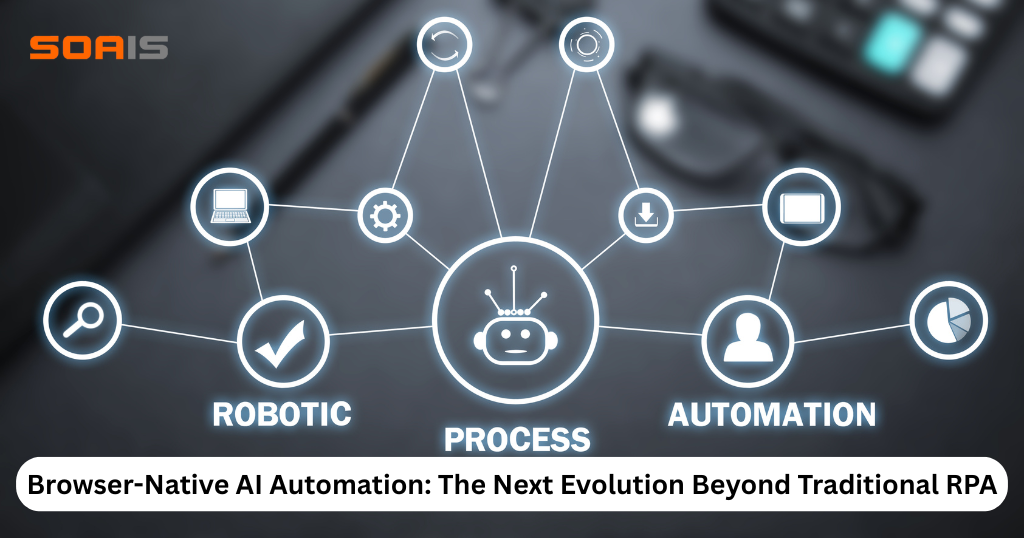
For years, enterprise web automation was defined by explicit, fragile scripts. Developers and QA engineers wrote hundreds of lines of code targeting hardcoded CSS selectors, XPath expressions, and visual coordinates. When a UI component shifted slightly, a button class renamed from .btn-submit to .submit-primary, the entire pipeline broke, triggering costly maintenance cycles.
Browser-Native AI Automation replaces brittle scripting with autonomous AI agents that perceive and navigate web applications like human operators.
| AI Agent Interaction Layer: Enables autonomous multi-step reasoning, dynamic element recognition, and direct execution within modern browser instances. |
1. Beyond Traditional RPA: Direct Browser Interaction
Traditional Robotic Process Automation (RPA) and legacy test automation frameworks treat web pages as rigid structures of DOM nodes. They depend on explicit step-by-step instructions: find element X, wait 2000ms, click element X, type string into element Y.
Browser-native AI agents fundamentally change this paradigm:
- Direct Web Interaction: Agents render the application within real browser contexts (Chromium, WebKit, or Firefox) and read both structural DOM trees and rendered pixels.
- Goal-Driven Execution: Instead of hardcoded procedures, you provide plain-English intent, such as “Log into the portal, download last month’s invoice, and compile line items into a CSV”.
- Contextual Adaptation: If an unexpected modal or cookie consent banner pops up, the agent detects it visually, handles the interruption, and continues toward its objective.
2. Technical Architecture: Playwright Meets Vision-Language Models (VLMs)
The foundation of browser-native AI automation relies on combining deterministic browser engines with non-deterministic multi-modal reasoning layers.
[ Natural Language Task Prompt ]
              │
              ▼
[ Vision-Language Model (VLM Engine) ]
  • Analyzes screenshots + accessibility DOM trees
  • Determines semantic intent & action plan
              │
              ▼ (Action Command: Click, Type, Scroll)
[ Browser Engine Execution (Playwright / Chromium) ]
  • Executes auto-waiting, fast DOM manipulation
              │
              ▼ (State Update & Feedback Loop)
[ Target Web Application ]
The Synergy of Automation & Multimodal AI
- Browser Drivers (e.g., Playwright): Provide high-speed, reliable browser control, auto-waiting, isolation, and cross-browser support. They supply the execution engine that performs actions fast and deterministically.
- Vision-Language Models (VLMs): Process visual screenshots alongside structured accessibility trees (roles, labels, and bounding boxes). The VLM acts as the “eyes and brain,” determining where to click or type based on semantic understanding rather than hardcoded DOM paths.
- Execution Loop: The framework captures page state, sends visual + structural context to the VLM, receives structured action commands (e.g., click(selector_ref) or type(“query”)), executes them via Playwright, and observes the updated page state.
3. Primary Enterprise Use Cases
| Domain | Application | Key Advantage |
| Autonomous Testing | E2E QA testing generated directly from user stories or natural language descriptions. | Self-healing test suites that adapt automatically to redesigns without breaking CI/CD pipelines. |
| Web Task Automation | Multi-step administrative tasks like cross-portal data synchronization, compliance verification, and form filling. | Handles dynamic forms, conditional dropdowns, and unpredictable step flows seamlessly. |
| Data Extraction & Scraping | Scraping complex, javascript-heavy web applications behind logins. | Extracts structured data based on visual context even when markup changes daily. |
4. Why Enterprise Adoption is Accelerating
Elimination of Maintenance Debt
In legacy UI automation, up to 60% of engineering time goes toward updating broken locators and timing issues. Browser-native AI agents reduce selector maintenance because they locate elements conceptually, just as a human does, by identifying labels, icons, and visual layout position rather than rigid CSS paths.
Handling Dynamic & Unstructured Web UIs
Modern Web Apps built on frameworks like React, Vue, or Shadow DOM frequently generate randomized class names (e.g., .sc-bdVaJa eKzOED) that defeat traditional scrapers. By analyzing accessibility trees and visual renders simultaneously, VLM-driven agents remain completely unfazed by obfuscated DOM structures.
Native Enterprise Scalability
By hosting headful or headless browser fleets in scalable cloud infrastructure (such as Browserbase or Playwright clusters), organizations can execute thousands of concurrent autonomous web tasks in parallel, dramatically cutting operational turnaround times.